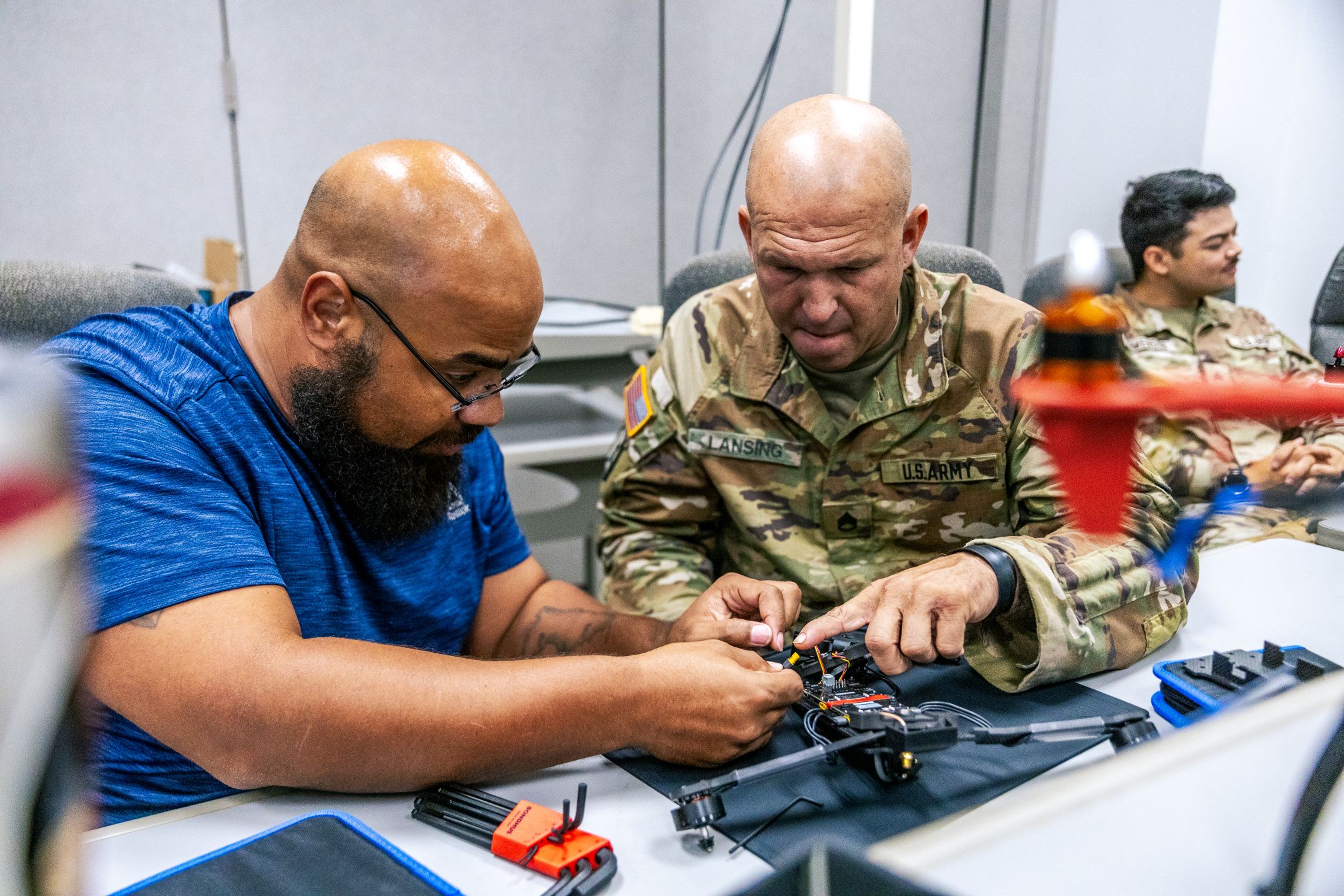
The COL Ralph Puckett Workforce Development Center is a purpose-built, student- and employer-centered hub of Columbus Technical College that connects veterans, service members, military families, and the broader Columbus community to education, credentials, and direct employment pathways. Operating as an extension of CTC and aligned with Georgia’s statewide VECTR network, the Puckett Center delivers flexible training, industry-driven programs, and wrap-around support that shorten the path from learning to meaningful work. By partnering with employers from the outset and focusing on high-demand, high-wage careers, the Center strengthens the regional workforce, retains military talent in the Chattahoochee Valley, and serves as a welcoming front door to opportunity for all who seek to learn, serve, and succeed.
Columbus Technical College has been formally recognized by the State of Georgia as a Purple Heart College, honoring the institution’s commitment to supporting veterans, active-duty service members, and Purple Heart recipients through education, workforce development, and community engagement. This designation reflects Georgia’s continued dedication to those who have been wounded or killed in service to our nation and recognizes institutions that demonstrate exceptional support to the military community.


Want to learn more? Click here.
Puckett Center:
Monday – Friday(0800 – 1700)
2329 Fort Benning Rd
Columbus, Georgia 31903, US
Phone: 706-905-8473
Email : puckettcenter@columbustech.edu
Fort Benning Office:
Mondays – Thursdays (0900 – 1530)
Friday (0900-1200)
Soldier for Life Building, ACES, Building 9230, Room 1331
8150 Marne Road
Fort Benning, GA – 31905
Phone: 706-649-1914
Email : military@columbustech.edu
Click here to view what our Financial Aid Office offers
Why a Transitioning Service Member Should Consider a Technical College SkillBridge Over a Traditional Company-Based Program?
Every transitioning Service member faces a decision that rarely gets the attention it deserves. Somewhere between final medical appointments and clearing post, there is a quiet but consequential choice:
How should I use my final 180 days in uniform?
For many, the answer seems obvious. They secure a company-based SkillBridge internship. They will embed with a specific employer, learn that company’s systems, and, if everything goes well, convert to a civilian job offer. That path can work. In some cases, it works extremely well. But there is another model that deserves equal consideration: a technical college–based SkillBridge program.
The difference between the two approaches is subtle on the surface, but significant in long-term impact.
Training for a Job vs.
Building Career Capital
A traditional company-based SkillBridge is typically structured around one organization’s workforce needs. The Service member trains inside that company, often learning proprietary systems, processes, and culture. If the internship converts to employment, the transition can feel seamless. But that model ties the outcome to a single employer.
A technical college SkillBridge operates differently. Instead of training for one company, the Service member trains for an industry. The focus is on earning portable, recognized credentials, commercial driver’s licenses, welding certifications, HVAC licensure, cybersecurity certifications, logistics credentials, healthcare certifications; qualifications that belong to the individual rather than the employer.
That distinction matters.
When credentials are portable, opportunity is not dependent on a single hiring decision. The Service member leaves the military with something durable; proof of skill that can be leveraged across multiple companies and even multiple states.
Department of War policy ensures that Service members do not incur program-related costs while participating in SkillBridges. Technical colleges are uniquely positioned to leverage federal, state, and workforce funding streams to structure credential-based pathways that meet that requirement while preserving quality and rigor. The result is not just an internship. It is structured education aligned with civilian industry standards.
Alignment With Real Workforce Demand
Across the country, employers continue to face shortages in skilled trades, healthcare, logistics, information technology, and advanced manufacturing. In many regions, high-demand career lists consistently highlight roles such as welders, HVAC technicians, CDL drivers, information security analysts, and logistics professionals. Technical college SkillBridge programs are often designed intentionally around these sectors. Rather than aligning with a single employer’s immediate hiring need, they align with verified labor market data and regional workforce gaps.
This broader alignment increases resilience. If one employer slows hiring, the credential still holds value across the industry. It creates optionality in a way that a company-specific internship may not.
Structure, Accountability, and Measurable Skill
Another meaningful difference lies in structure. A company internship may provide valuable exposure, but the training model can vary widely depending on the organization. Some programs are highly structured. Others rely heavily on shadowing or informal mentorship.
A technical college SkillBridge typically follows a defined curriculum. It includes classroom instruction, hands-on lab work, certification preparation, assessments, and often employer engagement built into the program. Learning objectives are clear. Competencies are measurable. Completion results in a credential that can be independently verified.
That structure reduces ambiguity. It creates tangible outcomes.
Risk and Optionality
One of the least discussed aspects of transition is risk. If a company-based SkillBridge does not convert to employment, the Service member may leave with valuable experience, but not always with a credential that broadens opportunity elsewhere.
In contrast, if a technical college SkillBridge does not immediately convert with one employer, the credential remains. The Service member retains industry recognition, expanded employer exposure, and often continued academic pathways. The foundation remains intact. Optionality is preserved.
For many transitioning Service members, especially those changing industries, relocating families, or seeking long-term stability, that flexibility can be decisive.
Choosing Intentionally
None of this suggests that company-based SkillBridge programs are inferior. For a Service member who is certain about an employer and confident in long-term alignment, that path can provide an efficient on-ramp to civilian employment.
But for those seeking portability, broader market leverage, structured credential attainment, or a transition into a new field, a technical college SkillBridge may provide stronger long-term positioning.
The final 180 days of military service are more than a runway to the next job. They are an opportunity to build durable career capital.nThe question every transitioning Service member should ask is not simply, “Where can I intern?” It is, “What will I own when this uniform comes off?”
That answer may shape the next decade more than the next job offer.